Pruning
Thinning
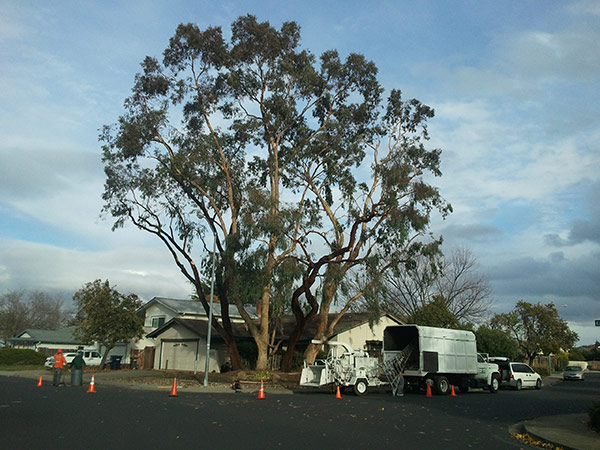
This is our most common and basic type of pruning. It’s important to note that it DOES NOT change the size or shape of the tree. This type of pruning is considered the “maintenance” kind of pruning and is considered to be the least intrusive to the tree. Our climbers usually start the pruning at the top center portion of the tree and work their way around removing dead, and broken branches as well as branches that “cross” each other so long as removing the crossing branch does not have a bigger negative impact on the trees overall aesthetics and health. This usually occurs when the crossing branches have been left uncut and allowed to mature and now serve a vital role to the tree. The climbers will also remove some of the live foliage to lighten up dense areas. A good way to envision what effect thinning will have on a tree is to imagine poking holes uniformly through a piece of paper; this will allow the air to circulate through to help prevent bad breaks as well as to allow sunlight to reach into the interior of the tree. Thinning promotes better health and prevents branch or whole tree failure. If a tree company is solely using a chainsaw to thin your trees then they’re not properly thinning your tree and are most likely going to cause damage to your tree/trees as described in our Bad Pruning section. During the thinning process, Stumpy’s Tree Service utilizes pole pruners (loppers at the end of a very long pole) which allows us to reach out to the tips and every part of the tree. The idea is to perform a uniform and thorough pruning.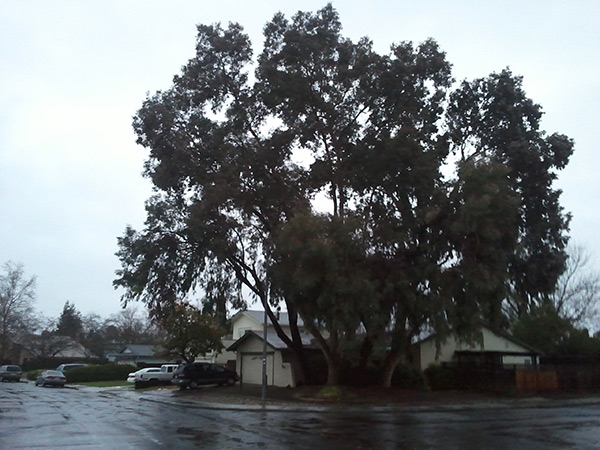
Reduction
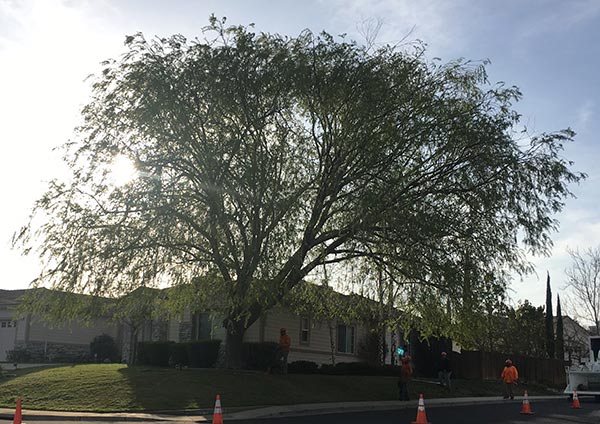
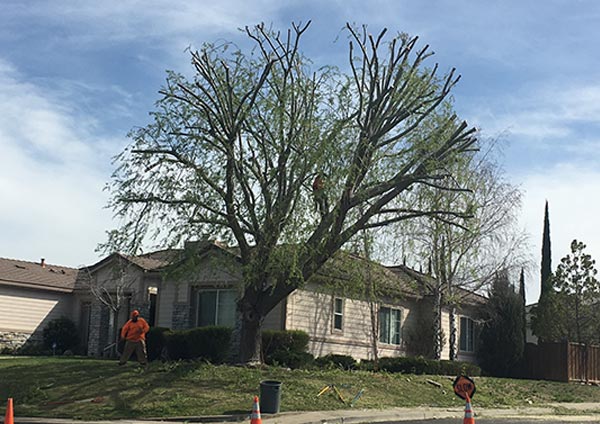
The most notable aspect of this type of pruning is that it will make your tree smaller. We describe the amount that should be removed by percentage. For example, if your tree is 40 feet tall (considering the bottom is the point at which the trunk meets the ground and the top is the foliage at its highest point in the canopy), a 25% reduction in overall size will leave the tree with a new height of approximately 30 feet.
Normally, during an overall reduction, we don’t just reduce the height, we also pull in the sides of the tree, and, since trees naturally grow well shaped, the idea is to end up proportionally the same shape. In some cases, trees have grown obstructed from the light, or they’ve been pruned incorrectly, in this case, they can be left with an imbalance and disproportional at which point we can reduce the tree accordingly. It is important to make cut sizes appropriately proportional to the size of the tree. If the pruning is too aggressive, and excessively large diameter cuts are made, it is then referred to as “Topping” and can leave your tree deformed and stressed, which can ultimately lead to the tree’s death.
Read more about Topping…
Various sources would state that it’s a rule of thumb to not remove more than 20-30% of a tree’s canopy at one time, but this is relative, and there are so many variables that can lead you to remove larger portions or to be more modest. Some aspects of a tree that dictate the aggressiveness of a reduction can be but are not limited to: species of tree, age and vigor, location, and past pruning procedures that the tree has already been accustomed to.
Crown Restoration
This type of pruning is usually performed when a tree has been severely topped and has been allowed to grow unruly with witches’ broom.
Depending on how long the tree has been neglected since it has been topped, restoring the tree to have a proportional and full canopy can take 2-3 seasons of growth and pruning.
Pollarding
You might have noticed a gnarly trunk with nubs protruding out of someone’s lawn while driving around your neighborhood. Ironically, this is the 2nd most aggressive type of topping and was once considered a common practice and is referred to as pollarding. In today’s time, only if the tree was originally pollarded, is it deemed reasonable to continue this type of pruning since the effects of the original cuts are irreversible. This type of pruning was usually done to Mulberry trees to stunt their growth and limit the height and size of structural limbs. A pollarded mulberry tree will grow “fishing pole” like branches from the nubs, most homeowners like to cut these “fishing pole” like branches off the nubs every year before the leaves fall off to deter the amount of raking. Mulberry trees are so vigorous, they can easily grow back these “fishing pole” like branches every season, so in essence, a homeowner could have their shade during the summer and zero debris during the winter thus explaining why this became such a popular pruning practice.
Raise Canopy
If you have to duck to walk under your tree then you most likely need to have the canopy raised. Most cities will send a letter to homeowners who have a tree that hangs too low and hinders vehicles or pedestrians from getting by. Homeowners can notify the city that they have a scheduled date to have the canopy raised and officials usually waive deadlines. The City of Livermore requires that trees do not hang lower than 8 feet over the sidewalk, 10 feet off the edge of the curb, and 12 feet off of the street. In some cases, we can raise canopy to provide the clear passage of pedestrians and vehicles while maintaining the privacy that the tree provides.
View Restoration
Although trees can enhance the value and aesthetics of your property they can grow to obstruct a priceless view. Knowing how to achieve maximum view without “hacking” your trees can prove to be an investment.
Clearance Pruning
HOA’s, cities, and or fire departments can require a minimal established distance between trees/shrubs and structures (houses). Stumpy’s Tree Service can prune back the trees/shrubs so that there’s as much visible clearance pruning between them and the structures. Two to six feet of visible clearance pruning is common.
Separation Pruning
One may wonder what is the difference between clearance pruning and separation pruning. With clearance pruning, we can ensure a minimal gap between the tree and the house, perhaps 2 feet. However, the tree may still overhang the house while having at least a 2-foot gap between the tree and the house. The customer may decide that they do not want the canopy of the tree to overhang the house as much as it currently is, we can then pull the canopy line back. For example, if a tree’s canopy overhangs a house by 30 feet we can perform 15 feet of separation pruning so that when the pruning is finished the tree only overhangs the house by 15 feet as opposed to 30. This helps to reduce debris on roofs/yards.
Aesthetics isn’t the only thing to consider when performing separation pruning; balance of the tree is the most important aspect of separation pruning, it is possible to cause an unbalance which can render the tree dangerous.
PALM TREES
Canary Island Date Palm (Phoenix Canariensis):
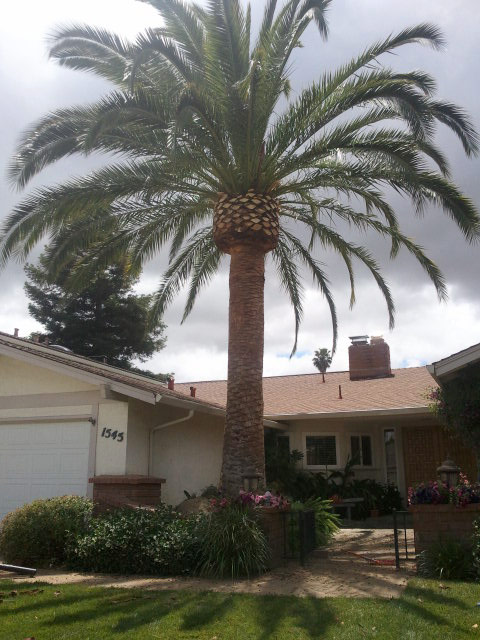
There are two main types of pruning when it comes to Canary Island Date Palms. Customers can simply have the old (dead) fronds removed (raise the canopy, removing seed pods is commonly included) or a combination of removing the old fronds and shaping the bulb and trunk. Note: The spines and germs in the tree make for a real hazard when pruning, therefore only expert insured personnel should prune these trees or any tree for that matter.
The Canary Island is a super exotic species, and when regularly maintained, adds significant value to your property.
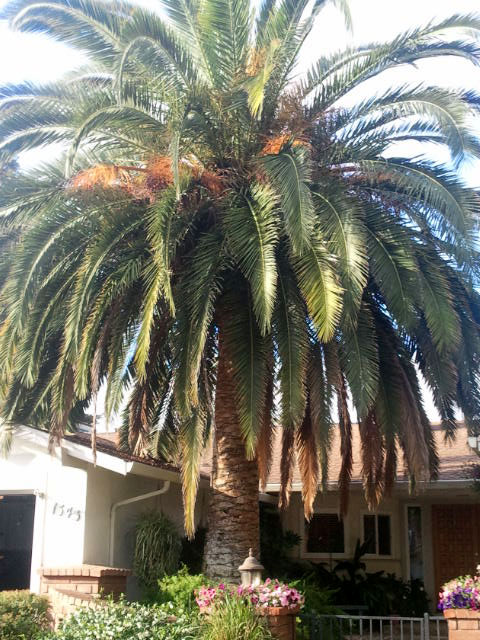
Fusarium Wilt Disease is a real epidemic with the Canary Island Date Palm Trees and measures should be taken to prevent infection from pruning which is currently the main culprit. Please Look at the Canary Island Date Palm in which we raised the canopy, shaped the trunk and bulb.
Mexican Fan Palms (Washingtonia Robusta):
Mexican and California Fan Palms also have two primary pruning options. The routine maintenance usually consists of removing old fronds and typically up to a height so that the remaining fronds resemble the shape of a ‘V,’ thus explaining why this common pruning is referred to as ‘V’ cut pruning. A luxury but not a necessity is to have the wraps around the trunk removed, we refer to this as de-wrapping as it gives the trunk a smoother, cleaner look.
Queen Palm Trees (Syagrus Romanzoffiana):
These palms differ from from Mexican and California Fan Palms in that the wraps around the trunk should not be mechanically removed for the potential of damage to the inner trunk. Wraps are usually removed by hand once they’ve matured enough to do so. The usual pruning of the Queen Palm Tree consists of removing old fronds and seed pods. They can be pruned in the same ‘V’ cut manner as the Mexican and California Fan Palm trees.
Yucca Tree (a succulent and no so much a palm):
These trees grow pretty much in the same form as palm trees. A unique aspect about the yucca tree is that it can grow and develop trunks from any point along existing stems. When pruning these types of trees Stumpy’s Tree Service typically removes all the dead fronds and a few unwanted structural limbs to achieve a well balanced and structurally uniform canopy.
We're Here To Help!
Call (925) 518-1442 or Contact Us for a FREE estimate.