Too often homeowners are caught up with the urge to go with the least costly tree estimate. Trees add value to your property, but most importantly it is the beauty and ambiance they create for your family and friends to enjoy. Understanding bad pruning can help you make the right decision when inquiring about tree service.
Moreover, this can be a starting point to get you set back in the right direction if you decide to ensure better preservation of your trees. Not all bad pruning is irreversible, through diligent pruning and time (phases) we can restore a tree to its original form and health, this is referred to as Crown Restoration. Feel free to review the different kinds of bad pruning practices below.
LIONS TAILING
This is the most common malpractice of bad tree service companies and we hope to shed light on this. It’s happening everyday in our neighborhoods and you can be sure that if you drove around the entire day looking for tree companies at work you’d find a tree trimmer pruning in this exact manner. What often happens is that a tree company estimates a job so low in cost that they can’t afford to pay a climber and the crew to take the time to properly prune a tree. They then climb up the center of the tree making big cuts with primarily a chainsaw, gutting out the center of the tree, and defoliating the interior part of all branches.
This is very bad for many reasons. The primary reason is that it actually makes the tree more dangerous, which defeats the purpose of why most people get their trees pruned in the first place. How could this make a tree more dangerous? In short, the tree uses all of its branches and foliage to distribute the force of winds throughout its entire structure, this is called dampening. And, when all the interior foliage is cut out, they no longer help to absorb the wind and only the tips get the entire brunt of the force and they end up breaking. It’s not uncommon to have customers call and say “we just had our trees pruned and now they are falling apart.” More often than not, these trees have been Lions Tailed. No customer should be distraught over paying someone to ruin their trees, and that is precisely the purpose of this page. Lions Tailing can be fixed, however it’ll be a phase of over a few years with the implementation of regular standardized pruning.
TOPPING
This would be the second most frequently occurring bad practice; however, it is the worst. Topping is the act of making a pruning cut too big. These cuts are usually so big that the tree can never heal the wound at which point it begins to dry and decay from the point where the cut was first made. Death and decay of the stem continue downward until the tree dies. Many people refer to this as the “12-year syndrome.” Topping is especially bad when it’s done to excurrent trees, most of which are conifers and usually have a conical form of growth such as pines, redwoods, cedars, and spruces. 90% of an excurrent tree’s growth is in the central leader, therefore when these trees are topped not only are they left with bad wounds but the trees are stressed and can be pre-exposed to disease or pests.
WITCHES BROOM
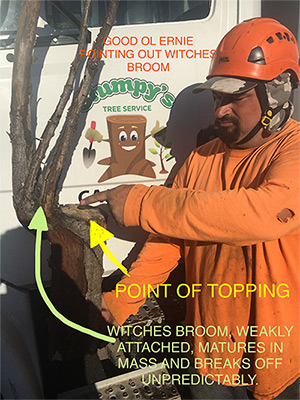
Witches Broom is more of a deformity from the result of Topping. Abnormal amounts and un-naturally attached foliage grows at the brim of the point of the topping, hence the name “witches broom.” The foliage then matures and when they gain mass, at a point of constant decay, they tend to break off at unpredictable times. The tree becomes a hazard, the biggest disservice of inexperienced tree companies.
This piece of witches broom depicted in the picture was removed from a tree that had continued dieback from the previous topping. The entire top and witches broom died. We tried cutting down lower at a point in which will prevent decay and allow the tree to heal properly, but the further down we went the bigger the cut we would have to make.
FLUSH CUTS
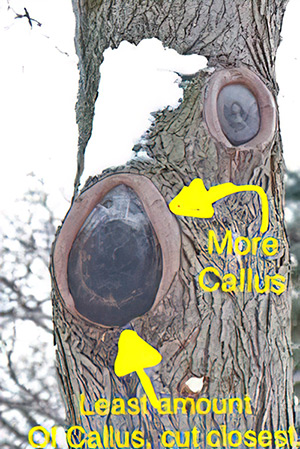
Untrained workers make cuts too close to the bark and tissue when removing branches; these bad cuts are referred to as flush cuts. Flush cuts don’t leave enough tissue so that the tree can grow callus to begin its healing and closure process. The result of flush cuts promotes extensive decay which can progress inward creating cavities into healthy tissue.
Cutting outside of the branch collar leaves enough tissue for the healing process. Look at Callus growth in the picture, the area of least callus growth is at the pointcut closest to the trunk. Bottom line: the flusher the cut, the worse off it is.
RIP CUTS
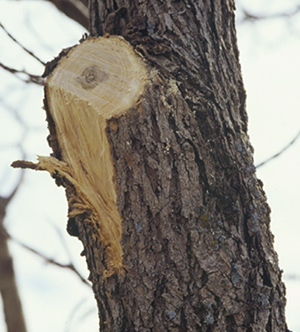
Improper pruning sometimes results in instant damage to the tree, such as when a rip cut occurs. The person making the cut fails to realize that when making a cut with a saw if they begin and follow through with a cut at the top of the branch there’s a possibility of tissue (usually bark) being ripped in a peeled downward-like manner from the weight of the branch itself.